

Coil winding of copper inductive components is a strategic process across multiple industrial sectors, where precision, thermal stability and production repeatability are critical key factors.
In environments where every electrical parameter directly affects the performance of the final system, working with a specialised partner makes the difference in efficiency and durability.
At Bobinados Osés, we run complete projects for the manufacture of electromagnets and copper inductive coils, always working to technical drawings and electrical specifications defined by the customer. Our approach combines electromagnetic engineering, dimensional control and thermal validation, making sure every unit meets the required magnetic field, electrical resistance and duty cycle.
Our experience in this field allows us to take part from the initial design phase through to industrialisation and series production, guaranteeing traceability, quality control and batch-to-batch consistency.
Call us
BOBINADOS OSÉS - Formulario de contacto INGLÉS
Electromagnets and inductive copper coils
Every project is developed to the customer's own technical drawing, so that the resulting component responds to a real application rather than a standard catalogue reference. From the first engineering conversations through to series production, we keep the same points of contact and the same quality criteria, which shortens validation times and reduces the risk of mismatches between design and finished part.

Copper coil winding for industrial electromagnetic applications
Manufacturing electromagnets and inductive copper coils requires deep knowledge of magnetic flux behaviour, current density and thermal dissipation under real service conditions. Every variable, from the number of turns to the wire diameter, has a direct effect on electromagnetic performance.
We design specific solutions for industrial relays, solenoid valves, electromagnetic actuators, contactors and advanced automation systems. In every project we define:
- Rated voltage
- Current intensity
- Required power
- Thermal insulation class
- Type of magnetic core
- Duty cycle
The goal of our coil winding process is to optimise the balance between magnetic force, energy efficiency and thermal stability. This guarantees reliable operation even in applications subject to vibration, high temperatures or continuous cycles.

Special windings
Enamelled copper wire coils: designed to your drawing
These coils are the functional core of any inductive system. That's why manufacturing them for electromagnetic applications requires strict control of conductor diameter, insulating enamel thickness and fill factor within the winding window.
Within our production process, we carefully select the type of wire based on:
- Maximum allowable current
- Target electrical resistance
- Thermal class (B, F, H or higher)
- Environmental conditions
We work to technical drawings, adapting each coil to the core geometry, optimising turn distribution and guaranteeing repeatability in production.
Types of coil construction
We develop different construction configurations depending on the connection system, the type of encapsulation and the final integration environment.
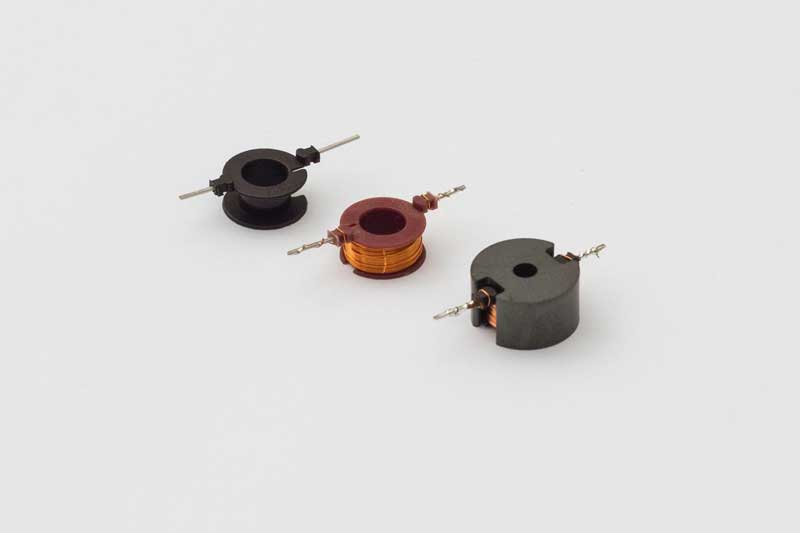
Pin coils
This construction is designed to simplify manufacturing by removing manual steps that would otherwise be needed on a coil without pins. It improves connection precision and offers high repeatability in large production volumes, and also makes it easier to connect onto PCBs.
Cable coil
This construction offers greater connection flexibility and adapts well to reduced spaces, and is especially suited to subassemblies where direct access to a board isn't possible.
Here, electrical continuity is guaranteed through controlled stripping, tinning and reinforced mechanical joining processes.
Braided coils
Braided coils are used when greater resistance to vibration, repetitive movement or demanding dynamic conditions is required.
Under high mechanical loads, using braided wire increases durability without compromising conductivity or electromagnetic performance.
Coils without pins
This construction is used when the connection between the coil and the system is made through cables rather than pins. As with cable coils, it offers greater flexibility and adapts well to subassemblies where direct access to a board isn't possible, with electrical continuity guaranteed through controlled stripping, tinning and mechanical joining.
This type of construction is common in special industrial automation projects and custom electromechanical devices.
Electromechanical integration: complete assembly
Beyond coil winding, we offer full integration within the final electromechanical subassembly.
Our production structure allows us to manage:
- Precision machining
- Technical plastic injection moulding
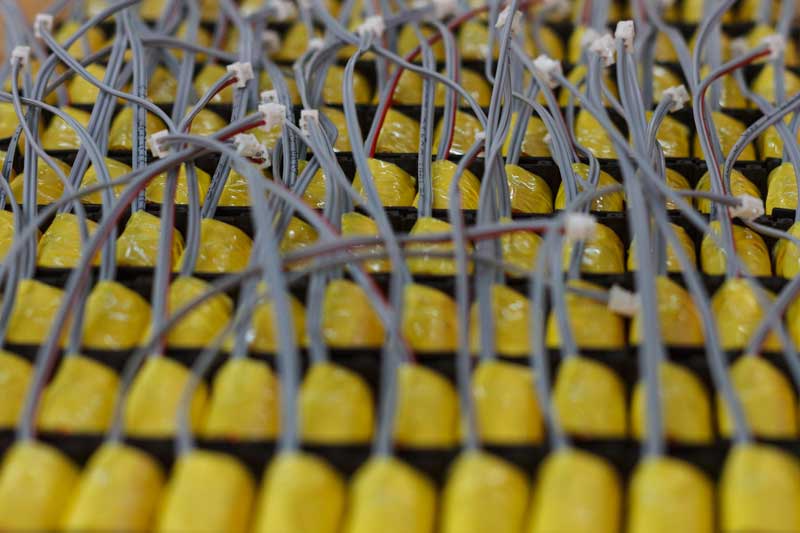
- Industrial wiring
- Electronic boards
- Stamping and riveting
Value-added processes
As explained above, we have extensive experience integrating electromagnets into complete electromechanical assemblies.
Thanks to our manufacturing experience, we can act as a single, integrated supplier, reducing the number of contacts you need and optimising industrial costs without compromising quality, reliability or traceability.
Frequently asked questions about copper coil manufacturing
What exactly is a coil?
A copper coil is an electrical component made from copper wire wound in turns around a core.
When electric current flows through the coil, it generates a magnetic field. The copper coil is the central element in the manufacture of electromagnetic actuation systems.
What materials are used to manufacture coils?
Our production process mainly uses:
- Enamelled copper wire
- Ferromagnetic cores
- Technical thermoplastic bobbins
- Metal pins or connection cables
Material selection has a direct effect on efficiency, electrical safety and the durability of the assembly.
How is the copper wire diameter defined?
Wire diameter is determined by the expected current intensity, the required electrical resistance and the allowable thermal dissipation. In electromagnet manufacturing, this parameter is critical to avoid overheating and energy losses.
How is the number of coil turns defined?
The number of turns depends on the required magnetic field, the applied voltage and the permeability of the core. This calculation is part of the electromagnetic design that precedes production, guaranteeing that the system meets its functional specifications.